Tending to the Dead in Central Appalachia
Over time, the responsibility for caring for the deceased shifted from families to professional funeral directors. Initially, communities came together to ensure prompt burials, with women preparing the body and men handling coffin construction and grave digging.
Before refrigeration and embalming techniques, individuals were buried swiftly to prevent decomposition. By the 1840s in central Appalachia, families began hiring undertakers, often cabinetmakers, who transitioned into this role due to their expertise and resources.
Embalming practices gained acceptance by the 1870s, allowing for elaborate mourning customs. By 1890 in Blacksburg wealthy deceased were embalmed in their home; however, as embalming became affordable, undertakers established dedicated spaces in their shops for preparation, shifting away from home visits.
Virginia led the way in requiring embalmer certification in 1894, following the establishment of the National Funeral Directors Association. By the 1930s, undertakers adopted the title of Funeral Home Directors, expanding their roles to provide community services like ambulance transport.
During the 1930s, funeral home vehicles served as both ambulances and hearses, highlighting the importance of trained personnel during transport. In 1949, the Lion’s Club, Jillian Wise, and a funeral director in Christiansburg collaborated to establish the first aid and life-saving crew, laying the foundation for the local Rescue Squad.
Reference: Death and Dying in Central Appalachia: Changing Attitudes and Practices by James K. Crissman, 1994
Thomas A. Helms – Blacksburg Undertaker between 1887-1928
Thomas “Tom” A. Helms hails from a family with a rich tradition in woodworking. His grandfather, Andrew “Andy” Helms of Mt. Crawford, Virginia, was a carpenter. Andy’s four sons followed in his footsteps: Joseph and Jacob became wagon makers, while Robert and Samuel McCune Helms (Tom’s father) pursued careers as cabinet makers.
Samuel McCune Helms was a cabinet maker living in the small town of Middlebrook, 14 miles from Steeles Tavern, at the time of the birth of his and Martha E. Stoffer Helms’ first child, Cora Virginia Helms (1853-1921). Tom was their fifth child, born (1 May 1860) just before Samuel enlisted in the Confederate Army on April 17, 1861, joining the 5th Virginia Infantry, Stonewall Brigade. Samuel was commissioned as a 2nd Lieutenant. He was captured at Spotsylvania Court House on May 12, 1864, and imprisoned in Delaware from May 16, 1864, to March 13, 1865. When he returned to Middlebrook he and Martha added three more children, including Minnie N (1872) and Alonzo S Helms (1874).
Samuel M. was well respected according to his obituary. He died 28 February 1911 and is buried near Steeles Tavern.

Samuel’s two sons, Tom and Alonzo Samuel Helms, continued the family tradition as cabinet makers and undertakers. Alonzo established his business near Steeles Tavern (formerly known as Midway), while Tom set up his practice in Blacksburg around 1886, as noted in his obituary.
Tom married Kitty Lee Puckett of Pearisburg in 1887 and they built a house on the SW corner of Main and Turner prior to 1915. Their first child arrived in 1889 and the last in 1904: Alonzo W. Helms (Lonnie, 1889-1960), Verner Louis Helms (1891-1917, lost at sea), Lillian Helms (1892-1957), Sally V Helms Timberlake (1894-1969), Samuel T. (1896-1961), Mary Lee Helms Nottingham (1898-1981), Guy N. Helms (1900-1973), John C. Helms (1902-1944), Minerva Helms (1904-1987).
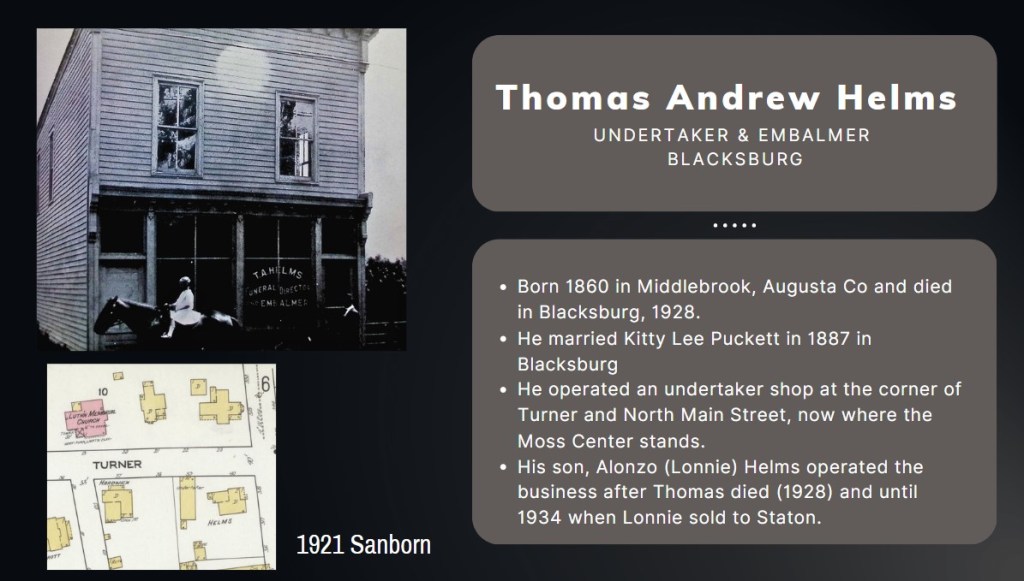

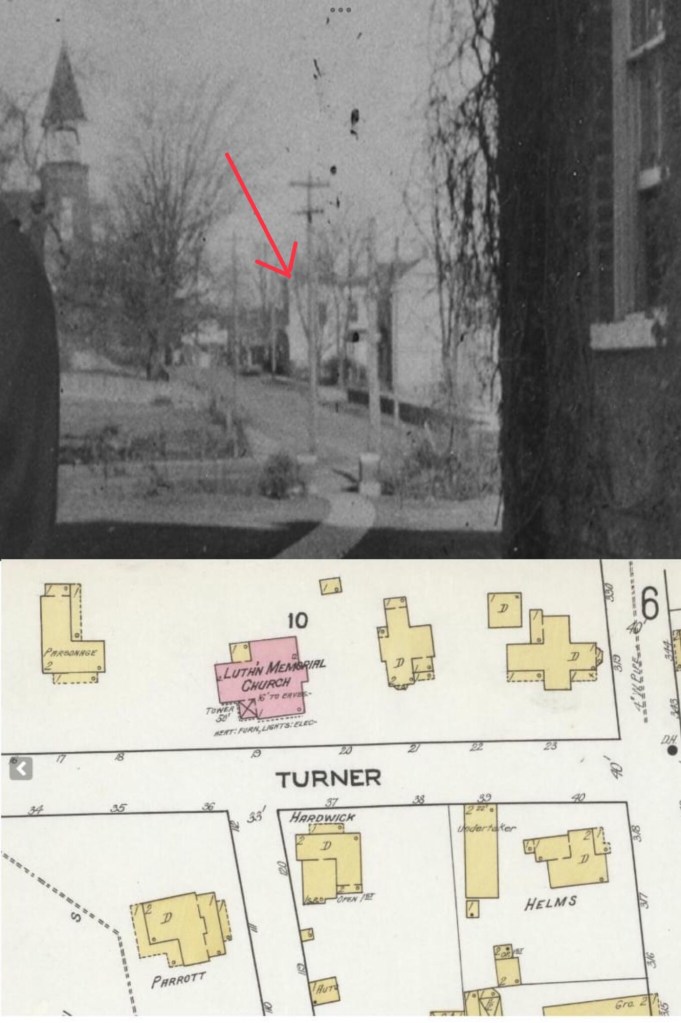
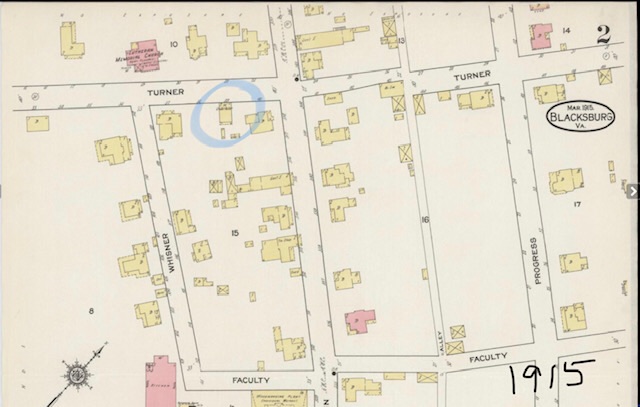

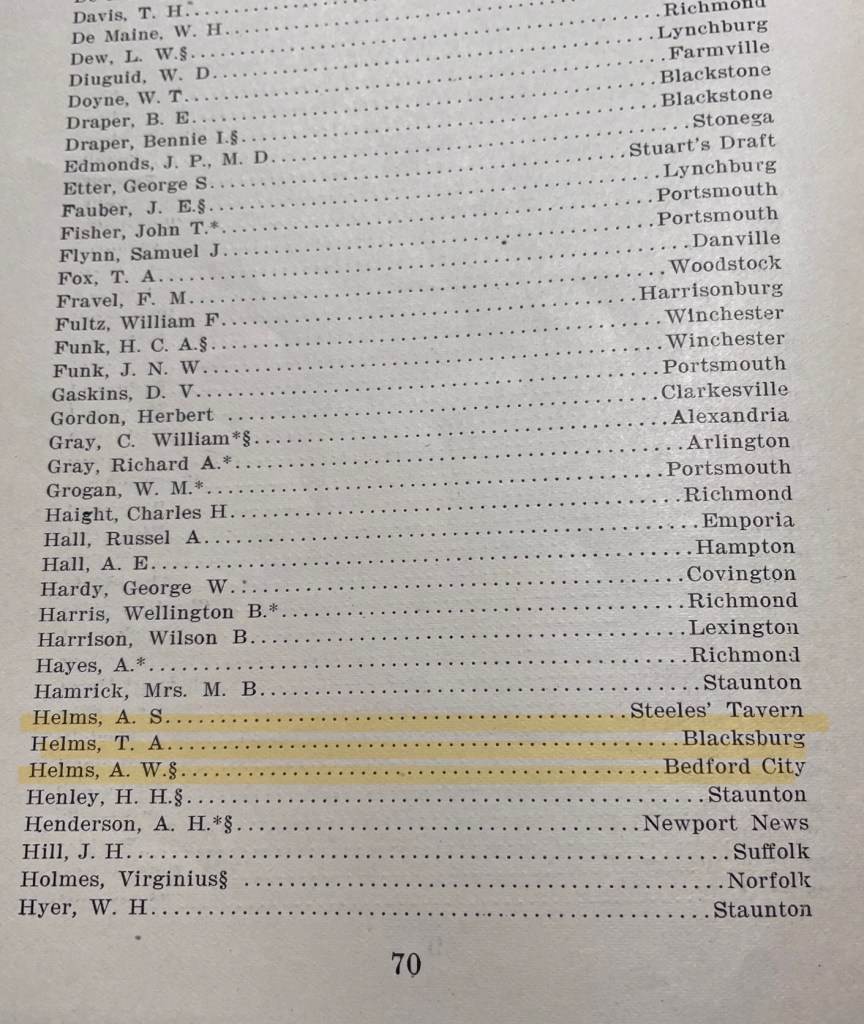

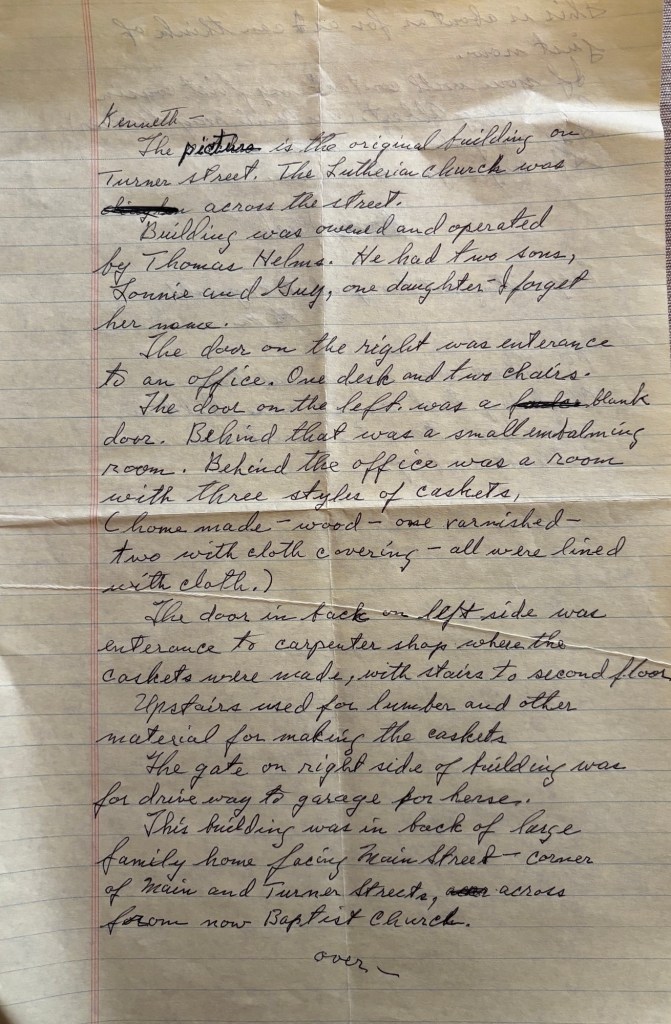
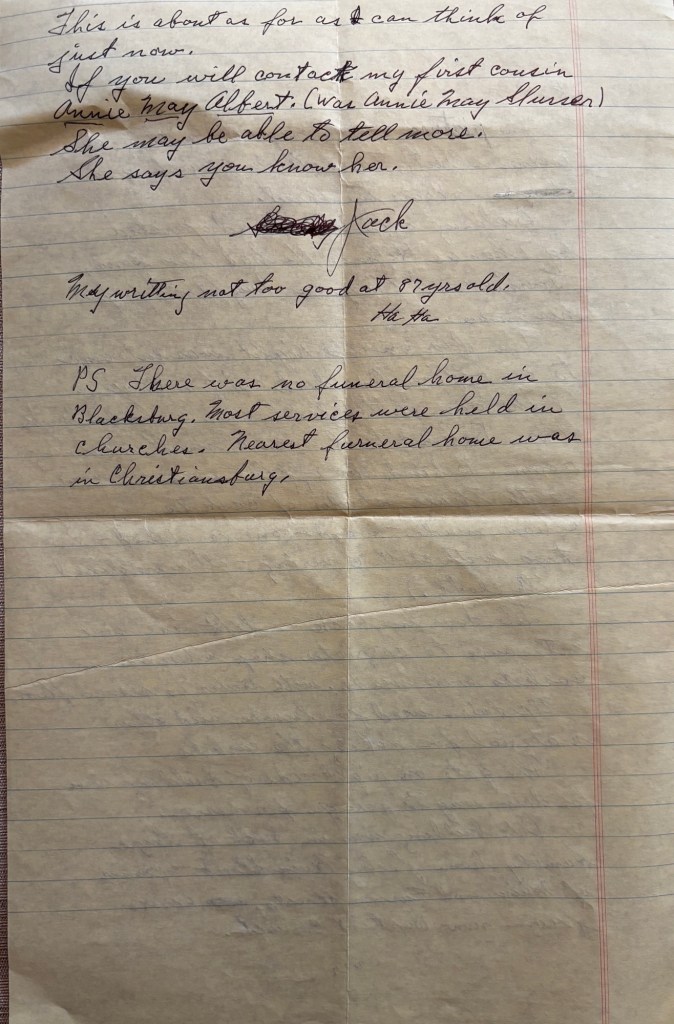
The undertaker building, which faced Turner Street (see photos and maps above), was a two-story structure with a coffin display room and office on the first floor. Most bodies were embalmed either at home or in a building like this, but were then returned home for the wake or viewing. The deceased would be transported by a horse-drawn hearse to the gravesite. Modern funeral homes did not become popular in this region until the 1930s.
After reviewing hundreds of death certificates from 1912 to the early 1930s, it is evident that many Montgomery County residents on the Blacksburg side were buried by Tom Helms or his son, Lonnie. However, the Helms were not the only company offering burial services. Tipton Byrd Evans (1847-1927), Samuel O. Barton (1832-1902), and Tom S. Milton (1892-1937) of Wake Forest, VA, also provided these services.
Thomas Helms served the residents of Blacksburg as Justice of the Peace, Town Council member, and Mayor in 1904. As Tom aged, his son Lonnie took over the family business. After Tom’s death in 1928, Lonnie continued to serve the community as an undertaker and embalmer.

One Envelope, A Regional Funeral Home Story
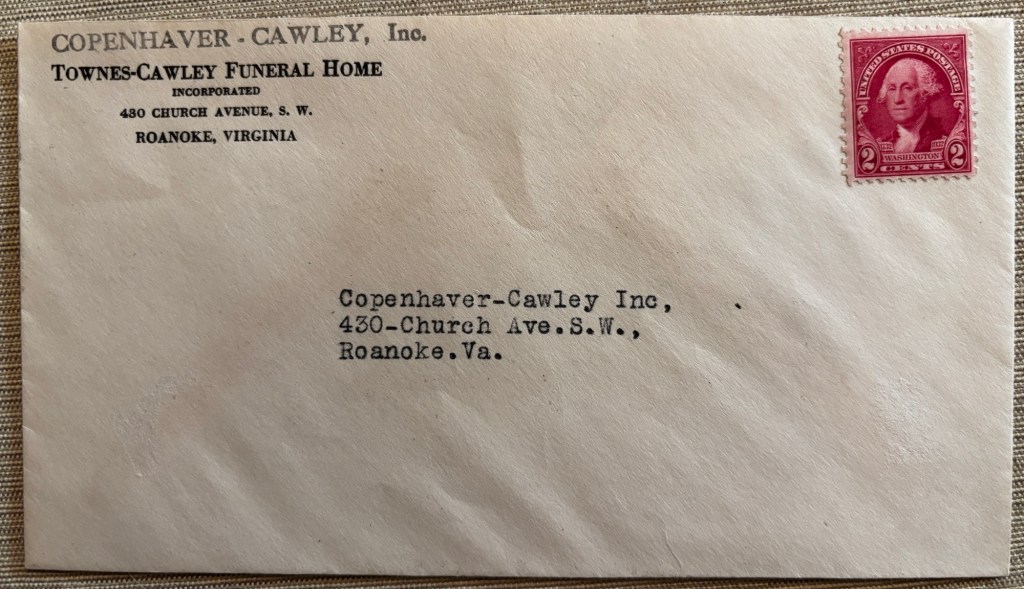
Sometimes a single envelope can lead us much farther than expected.
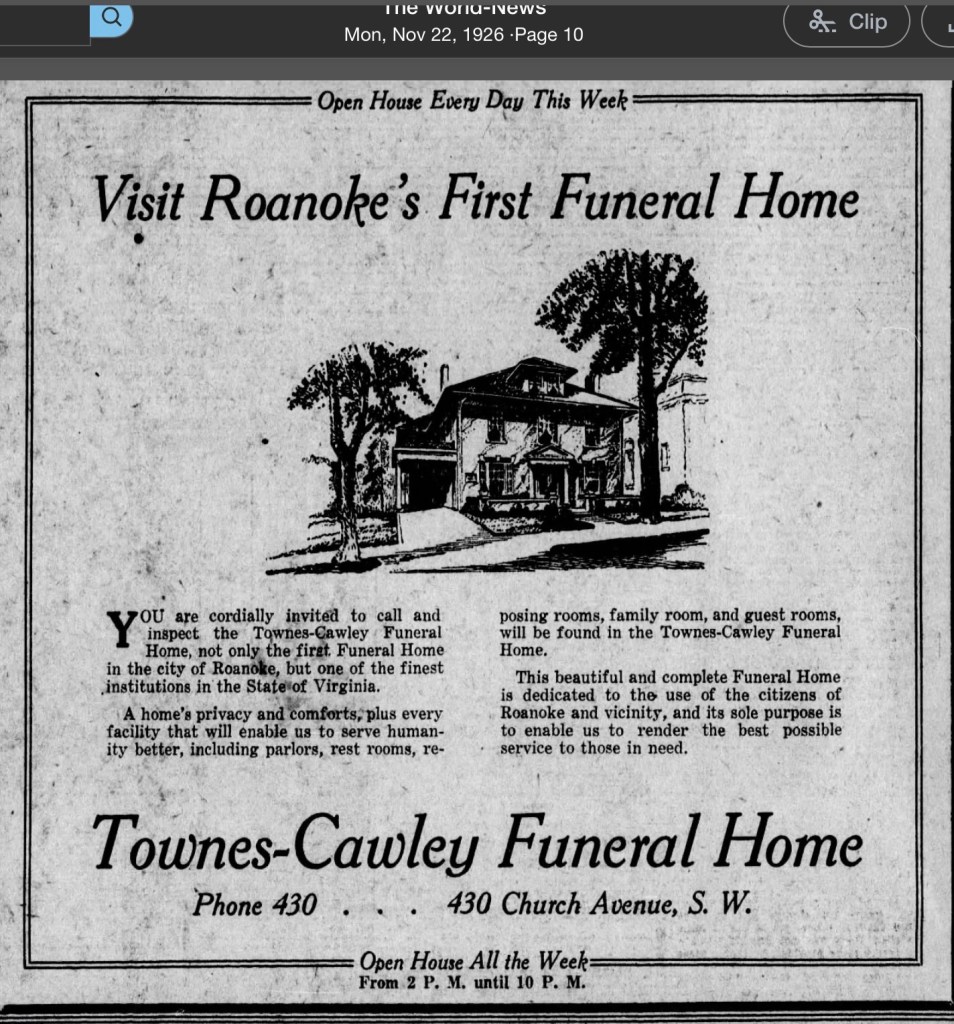
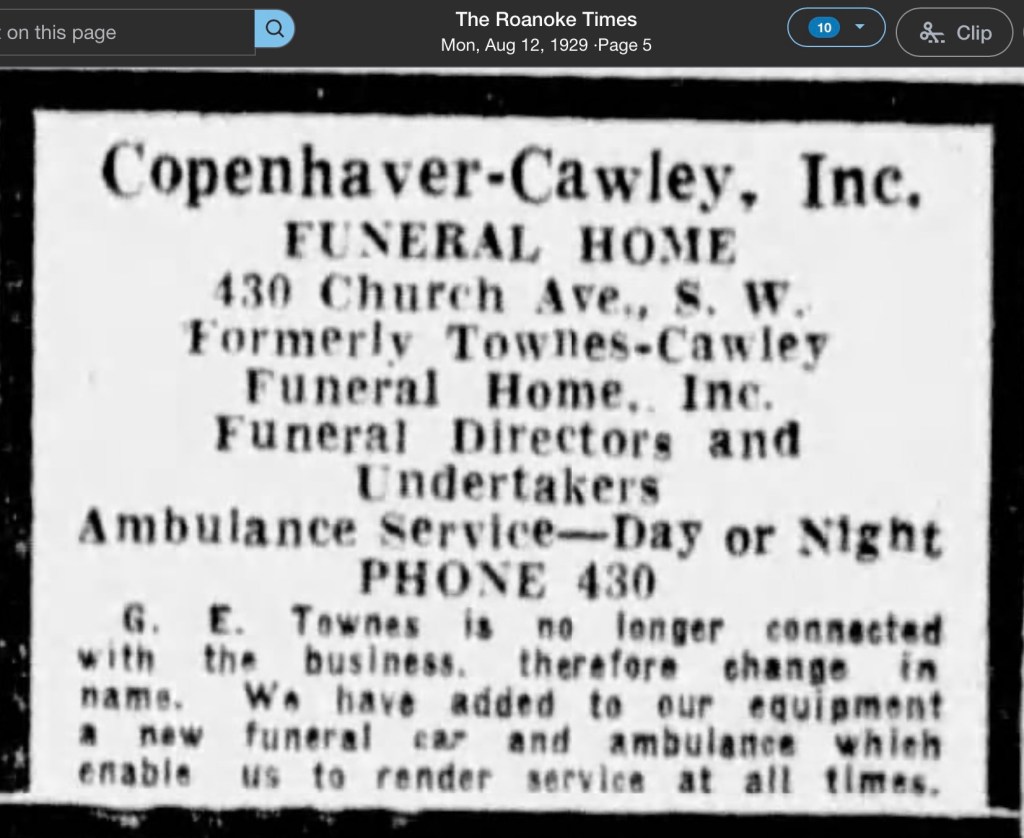
This envelope, from Copenhaver-Cawley, Inc., Townes-Cawley Funeral Home in Roanoke, tells a story that reaches beyond Roanoke and into the New River Valley during the 1920s, 1930s, and 1940s.
We have not yet found evidence that Copenhaver-Cawley itself tended to a deceased person from Montgomery County, but we have found evidence of other Roanoke funeral homes, including Oakey’s, serving families in the Shawsville and Elliston area. That connection makes sense. Montgomery County was linked directly to Roanoke by the railroad, making Roanoke an important commercial center for families and businesses throughout the region.
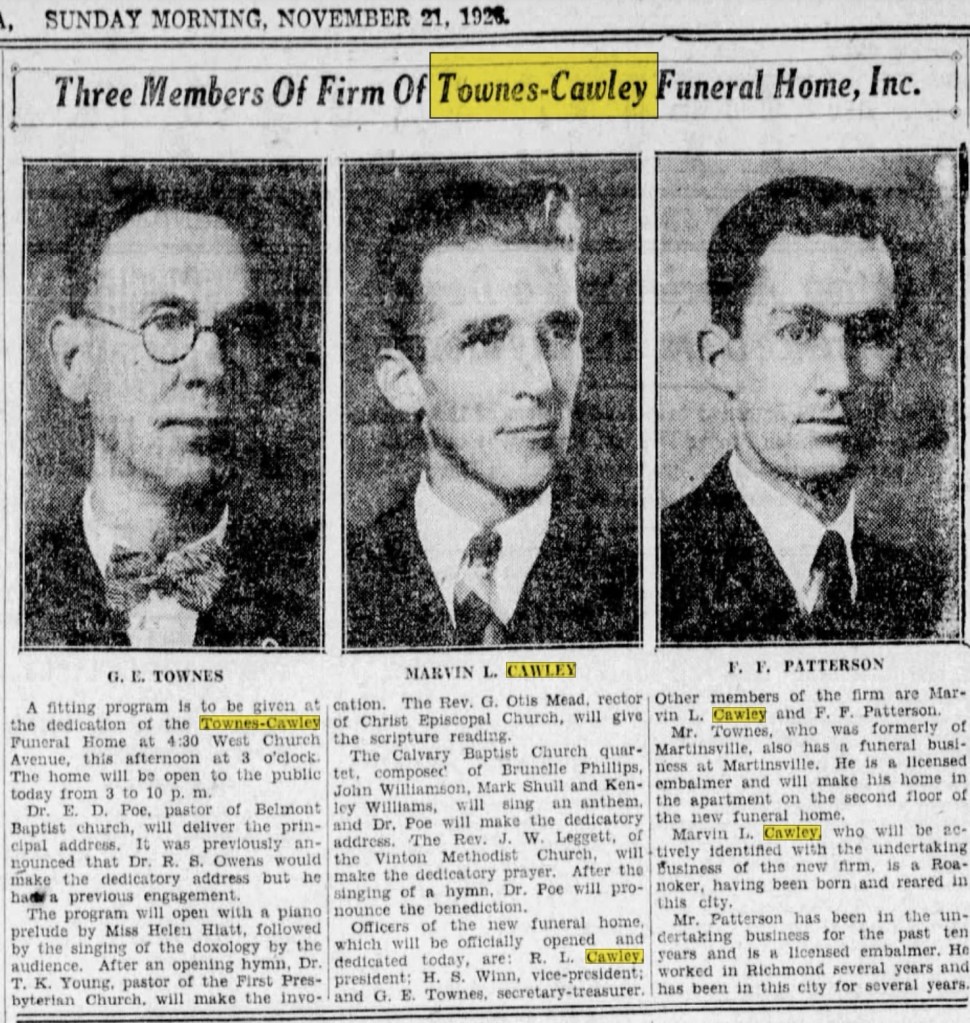
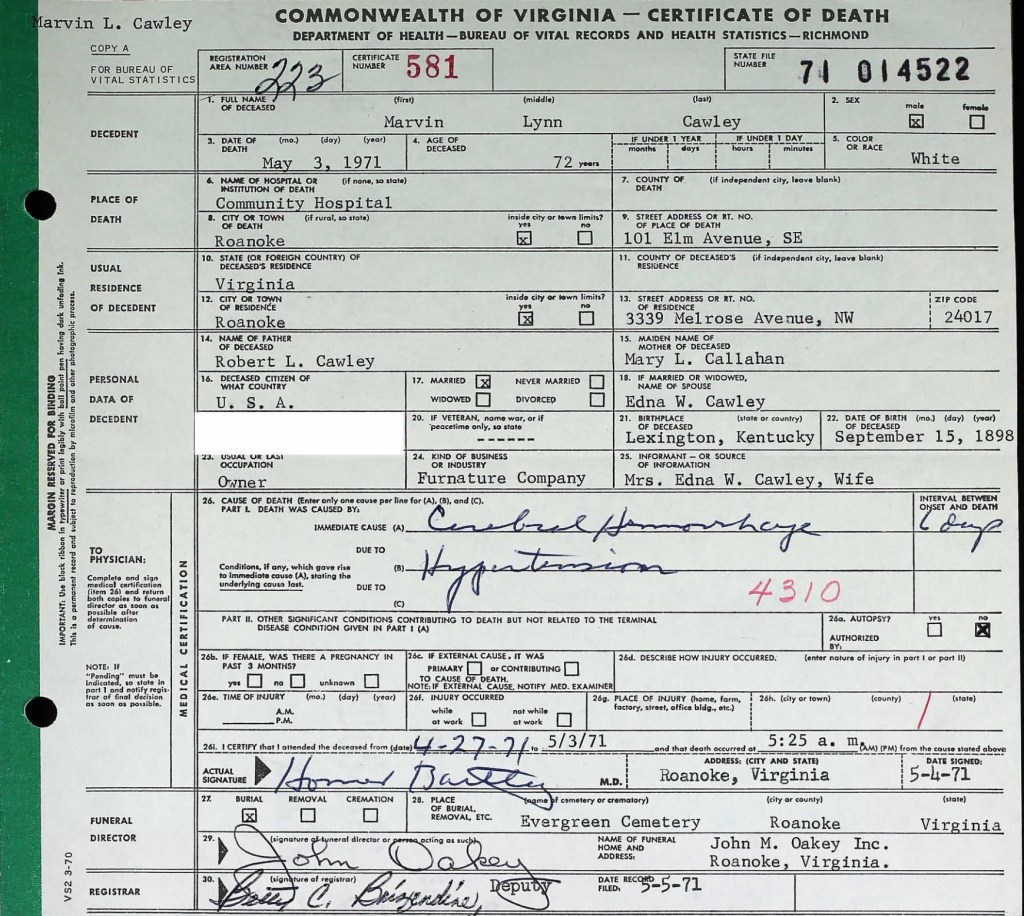
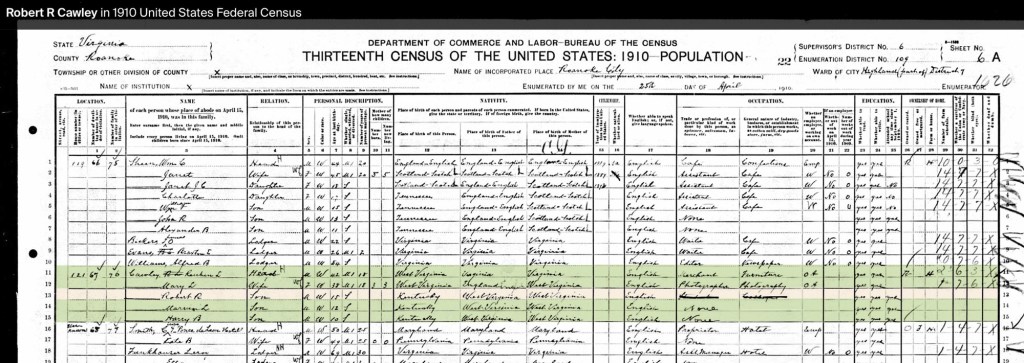
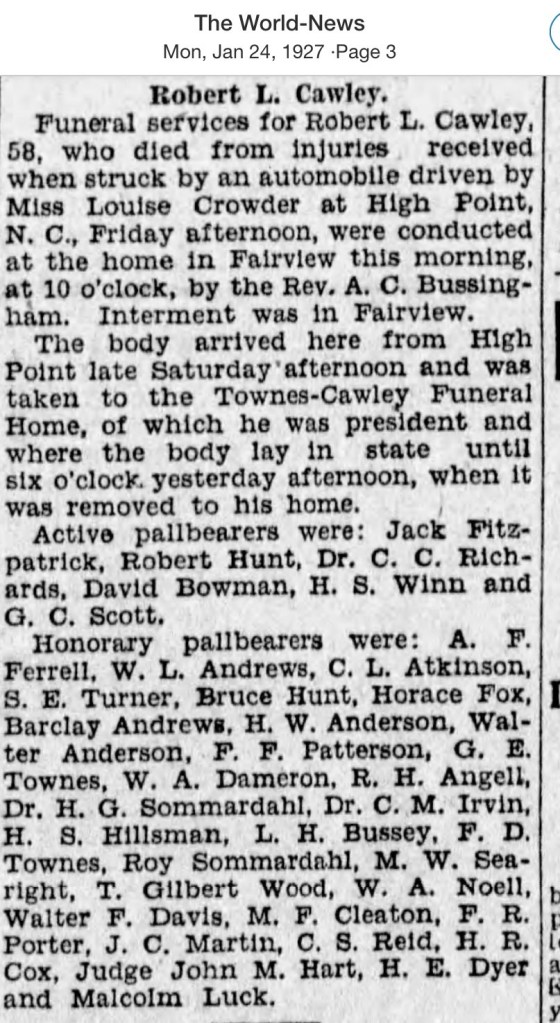
The story of this particular funeral home begins in 1926, when Robert L. Cawley (1868-1927) partnered with G. E. Townes, secretary-treasurer, H. S. Winn, vice president, his son Marvin L. Cawley, undertaker, and F. F. Patterson, licensed embalmer, to establish a new funeral business. The doors opened on January 1, 1927, at 430 West Church Avenue, SW.
Townes came from Martinsville and was a licensed embalmer. Patterson brought ten years of embalming experience from Richmond. Marvin Cawley was an undertaker and also operated the Cawley Furniture Company in Roanoke.
Then, just weeks after the funeral home’s opening, tragedy struck the family.
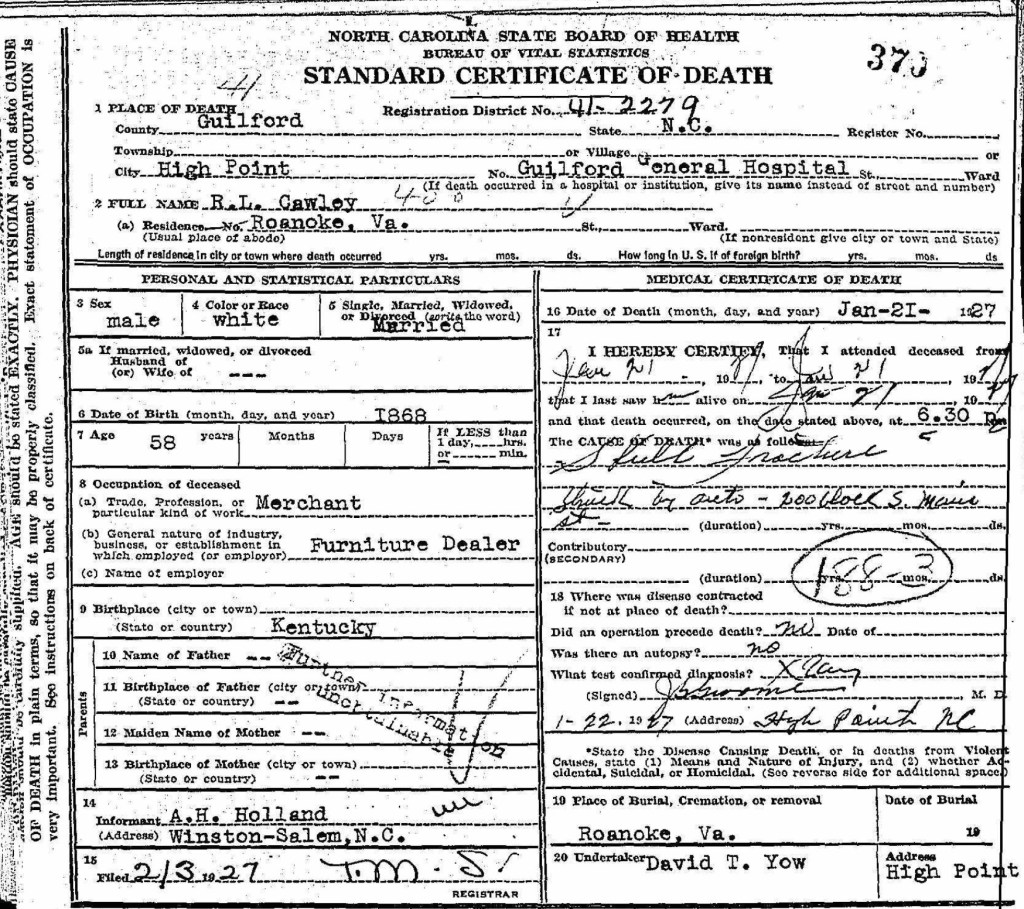
On January 21, 1927, Robert L. Cawley was killed in an automobile accident in High Point, North Carolina, while on a furniture-buying trip. His death came at the very beginning of the new funeral home’s history.
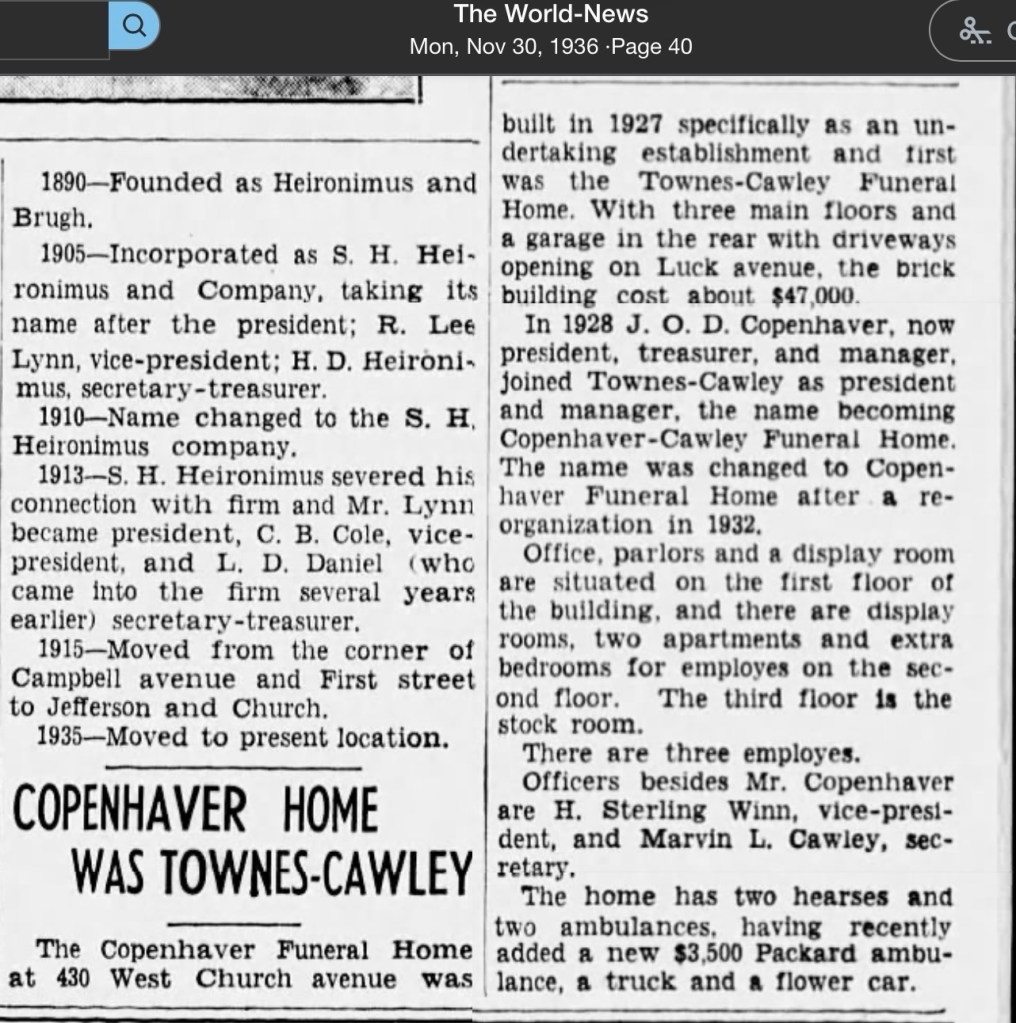
In 1928, J. O. D. Copenhaver joined the business as managing partner, and the name became Copenhaver-Cawley. By 1932, it was operating as Copenhaver Funeral Home, with Copenhaver in full control.
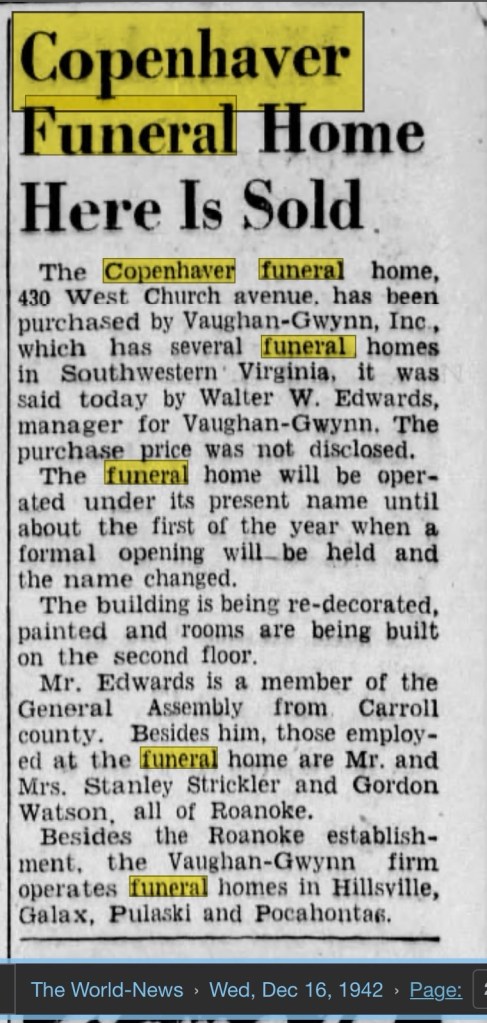
The business continued until 1942, when it was purchased by Vaughan-Gwynn. The Roanoke operation was then associated with funeral directors Stanley and Mrs. Strickler and Gordon Watson, with Watson serving as the licensed embalmer. The group also operated funeral homes in Hillsville, Galax, Pulaski, and Pocahontas, illustrating just how interconnected the funeral business had become across Southwest Virginia and the surrounding region.
There is another important piece to this story: furniture stores and funeral homes were often closely connected.
The Cawley Furniture Company began in 1912 at 503 South Jefferson Street in Roanoke. Furniture dealers were natural suppliers of caskets, and in some cases, as with the Cawley family, the same family was involved in both businesses.
So this little envelope represents much more than an address.
It points to a regional economy of death care, one that connected funeral directors, embalmers, furniture dealers, railroads, and families across Southwest Virginia. For communities such as Shawsville, Elliston, and elsewhere in Montgomery County, Roanoke was not a distant city. It was part of the commercial world they depended upon.
And this is exactly why objects like this matter to our research. We are still following the breadcrumbs. One envelope leads to a funeral home, which leads to a family, which leads to furniture businesses, transportation networks, professional licensing, and eventually back to the families of the New River Valley.
The envelope may not yet tell us who was carried through Copenhaver-Cawley’s doors from Montgomery County, but it has already helped us understand the larger world in which local families made arrangements for the dead.
There is still more to uncover.
 Gathering Blacksburg History
3 thoughts on “Thomas A. Helms, Undertaker in Blacksburg, Virginia”