
Streams, Springs, Rivers & Ponds
Blacksburg & Montgomery County Information
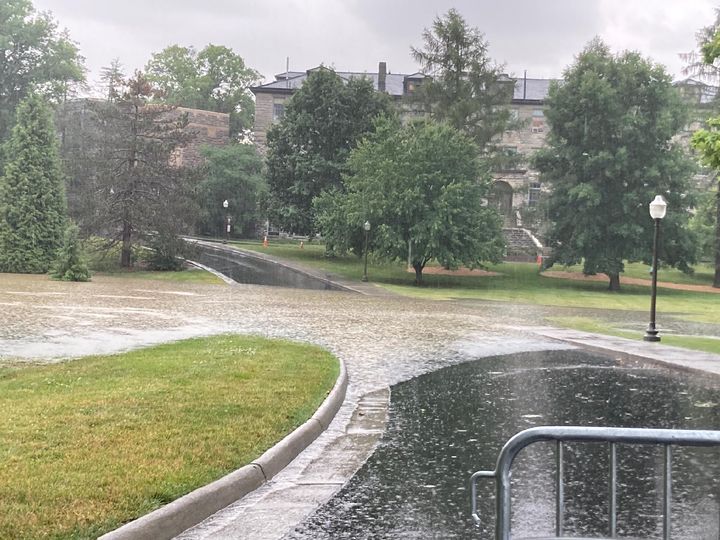
A dependable water source is crucial for the establishment of community settlements, and this was one of the reasons that William Black’s town was situated here. The Stroubles Creek is fed from two natural springs, that are north of town. The two branches are the Web and the Central Branch. The Central Branch that flows through culverts into the downtown area and under the Virginia Tech Drill Field where it daylights at the Duck Pond. The Central Branch was diverted into culverts on campus in 1937.
Stroubles Creek
- Stroubles Creek History Website
- Stroubles Creek Description and History According to this website, the upper ice pond was built in the 1880’s and the lower pond was built in 1934 when the creek that passed to the south end of the drill field was directed into underground culverts.
- Stroubles Creek Marker
- The Sixteen Frog Project to feature Blacksburg’s valuable water resource as well as highlight important citizens.
- Water Matters by Erica Stacy and Travis Williams
Springs
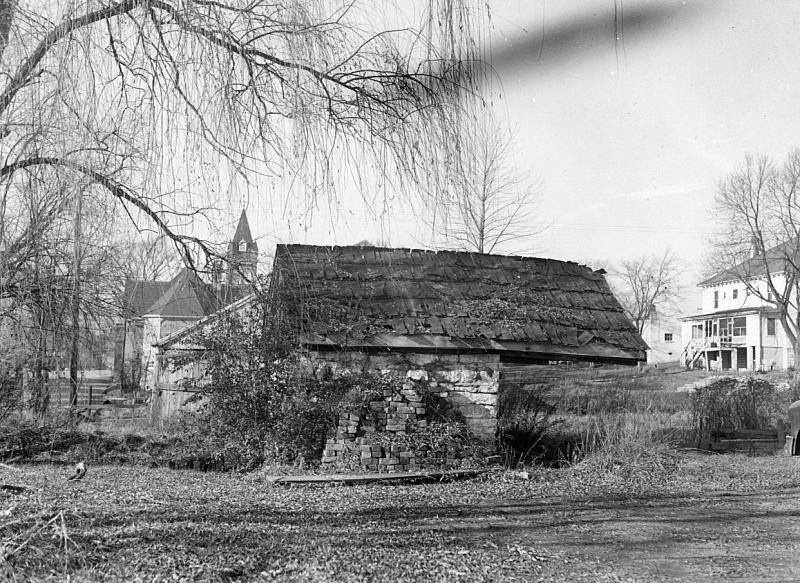
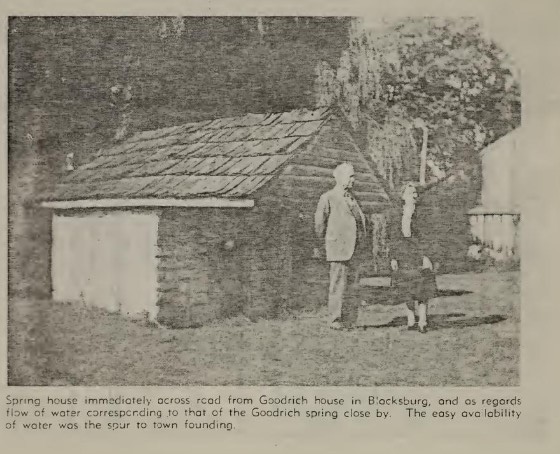
The original town spring was located about at the corner of Draper (Water Street) and Lee streets. Originally it was owned by the Goodrich family and protected by a log structure.
Three major springs supplied the Virginia Agricultural and Mechanical College (VPI), as mentioned in Temple’s The Bugle’s Echo, Vol 1.
The Quarry Spring, which was located about where Derring Hall now sits, was the only water source for the young college. Water was pumped via ram to the 1890’s newly built Agriculture Experiment Station tower (stood southwest of Burruss Hall and on the present Drill field) and Barracks Number One. All other water was collected in cisterns and either hand-pumped or carried.
In 1891, the college bought the 1 acre Painters’ Spring (also known as the Spout and Palmer spring) which is still located on northeast Clay street. At one time this spring was associated with David Sydney Painter family and Colonel William H. Palmer’s summer home, Mountain View. The water was gravity fed in pipes, through town, to a 14,000 gallon wood tank, which was named “The Round House.” The reservoir was located behind the Old Shops (Preston Olin) building.

Houston Family Big Spring Branch
The Board of Visitors, in 1896, bought 50 acres of the Houston Farm (southwest of the college) and with it, a bountiful spring (290,000 gallons/day). That spring was located about where Lane Stadium now stands and the water was pumped to “The Tank.” Beamer Way was originally named Spring Road.
The Tank
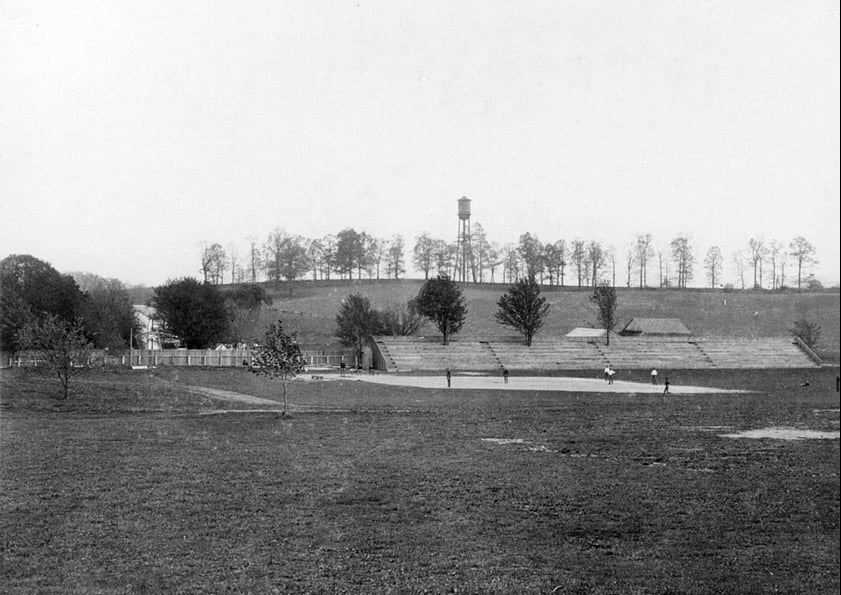
The distinctive water tower, called the Tank was built in 1896 to feed water to the campus. Professors William F. Patton and Lingan S. Randolph designed this 110 ft. high structure to hold 50,000 gallons of water. It was built on Sheib Field, about there Cassell Coliseum is now located. In 1957 it was no longer needed and razed.
Privies & Sewers
By 1900 Blacksburg’s spring fed water supply was imperil. Due to the lack of a sewer system residents depended on privies. VPI had created its own water and sewer system by this time and over the years encouraged the town to join forces. It was not until 1911 when the threat of typhoid convinced the town to work with VPI to solve their issues.
- 1911 Annual Report Commissioner of Health –
- Blacksburg, population 875, 28 January 1911 Report, Public water supply system “now being installed” and “public sewerage system”… “now being installed.” page 67.
- The State Commissioner of Health’s Blacksburg (1911) report on the water and sewage system is found on pages 69 to page 75 has been transcribed.
- Quotes from the report. Names and places of interest include Palmer’s Spring, Hoge Spring, Masons and Odd Fellows.
- “Blacksburg, Investigation January 9, 10, 1911. Blacksburg has a population of about 600 white and 200 colored, a total of 800. Immediately adjoining the town is the Virginia Polytechnic Institute with about 500 students. The institute is practically separate, having its own grounds and buildings, dormitories for students and residences for the faculty. The geological formation of the whole territory is limestone.”
- “Water Supply– Blacksburg at the present has no common system of water supply. The residents depend upon the various wells and springs, of which there are about a hundred scattered through the town. In the eastern part of the town there is a large spring from which water is conveyed through a two-inch wrought iron pipe. This supplies the hotel, the school and several houses along Main street. This pipe has been in use for several years, and is probably seriously rusted. The yield from the spring, known as Palmer’s spring, is said to be from fifty to eighty gallons per minute. The difference in elevation between the town and the spring is not sufficient to give adequate pressure for fire protections, even if there were a suitable main to supply the water. “
- “Sewerage.- The town has no system of sanitary sewers. The investigation showed a great many unsanitary privies, which are seldom, if ever, cleaned out, and several of which are built over Stroubles creek, flowing through the center of town. Several residences which are supplied by the two-inch pipe from Palmer’s spring have installed plumbing fixtures and discharge their sewerage into cesspools. The underlying rock is limestone, and is generally only a few feet under the ground surface, the top soil being of heavy clay. As a result, most of these cesspools extend down into the limestone and the sewage is supposed to be carried away through fissures and passages which always exist in a limestone formation. In one particular instance, the cesspool was extended down until an underground stream was reached, and since then there has been no further trouble in getting rid of the sewage discharged into it. Another instance, and perhaps the worst that this department has ever come across, is the cesspool on the hotel premise which was formerly a well forty feet in depth. When plumbing fixtures were put in, water was taken from the two-inch line and the well then changed into a cesspool. Several instances were discovered where the sewage was discharged directly into the creek.”
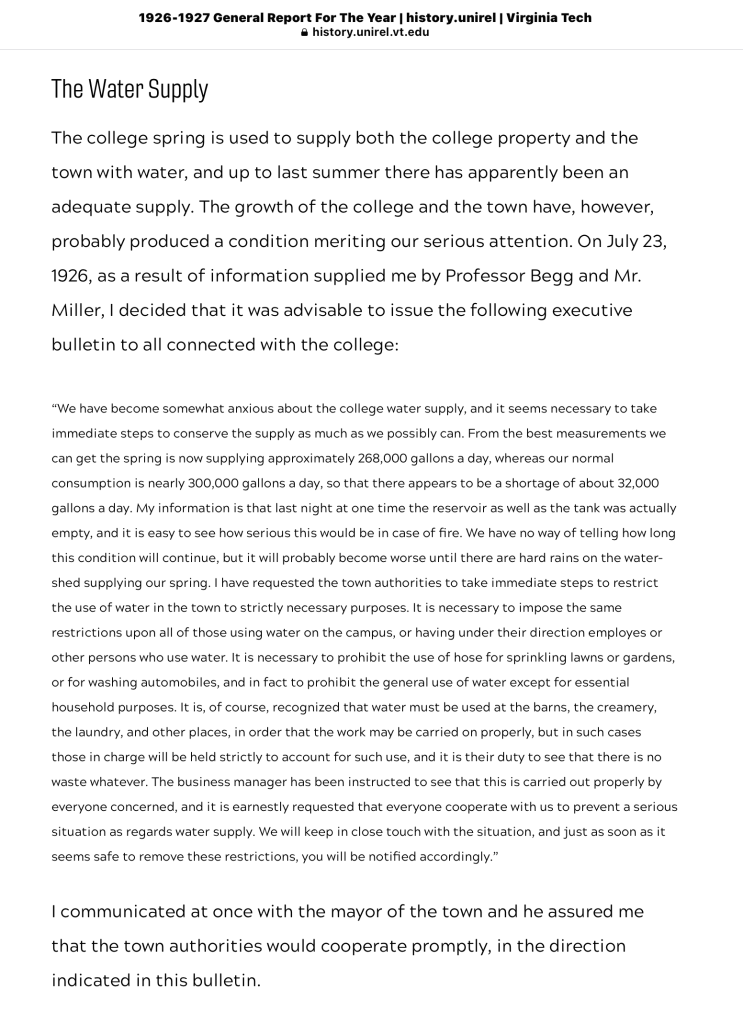
The President J. Burruss’ 1926-27 General Report
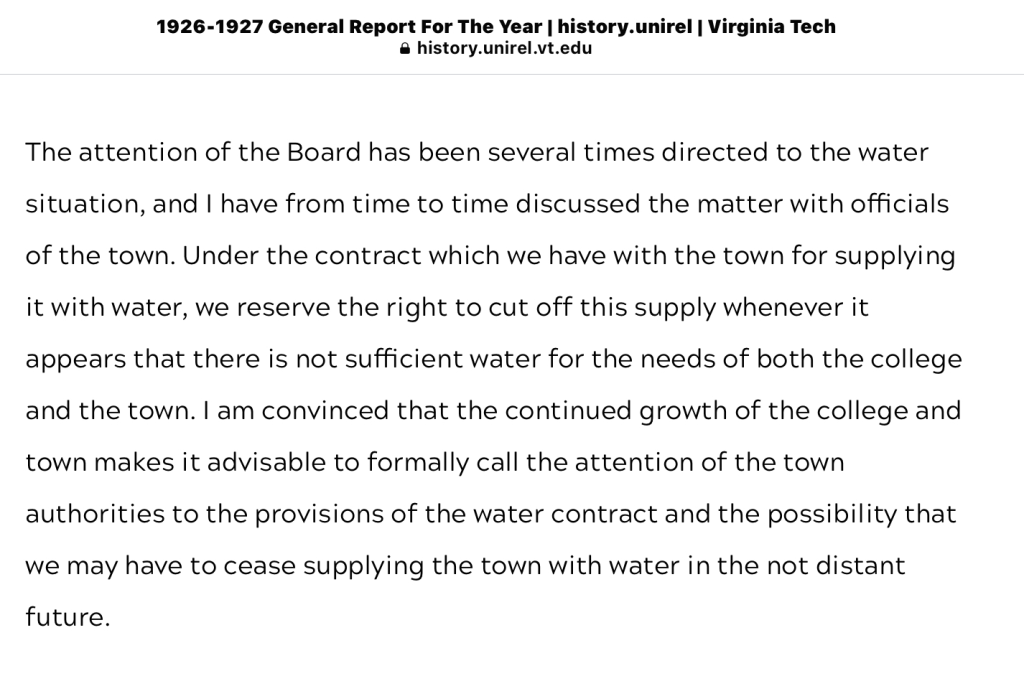
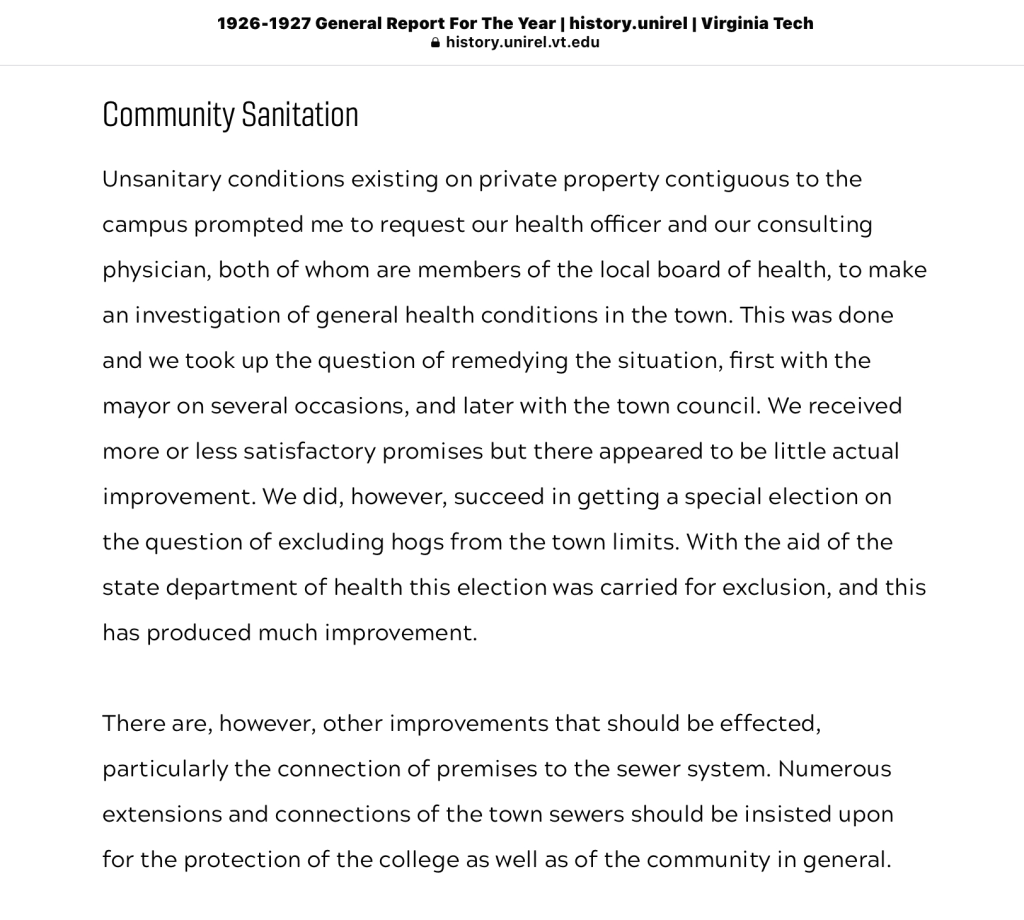
The whole report is interesting and illustrated how the town depended on the college for some basic services. The section on water and sewage are of interest. Dr J. Burruss mentioned a drought affecting the college’s spring output (bought from the Houston family in 1896). The water use by both the town and college outpaced spring replenishment capacity. This was a dire concern. The administration threaten to cut off the water supply to the town if the supply to meet the college’s need was not adequate. At that time the town depended on VPI for water after the 1911 typhoid outbreak.
Note the request to the town to ban pigs from the town limits. This is tied in with on-going sanitation issue within the town. John S. William (following) evaluated the sanitary conditions of the college and town and identified sanitation issues ten years later.

1936 Inspection Report of Blacksburg and VPI Water and Sewerage Systems
John Stuart Williams provides a 1936 view of the town drug stores, restaurants, hotels, boarding establishments, and grocery stores, through the lense of a sanitary inspector. His report includes the college mess halls, dairy, creamery, and dormitories. He even lists the dairies selling milk to both the town and the college.
His thesis, Sanitary Surveys of the Town of Blacksburg, Virginia and Virginia Polytechnic Institute Inspection, was submitted for the Master of Science in Biology, VPI. The thesis was split into two sections to reduce the size of the files (both are searchable PDF), Blacksburg and VPI. (The thesis is courtesy of Blacksburg Museum & Cultural Foundation.)
Williams thesis is loaded with a lot of interesting information that would interest the historian and biologist. He describes the potable water supply and treatment system used by both the town and college (both spring feed and chlorinated) as well as the only sewerage system available to the town, faculty houses and college buildings. Fun fact – the showers and toilets in the original dorms on the “Quad” were located only in the basement. He describes the number of doctors, dentists, hospitals for both the town and college. The water quality of based on the bacteria growth on plates indicated that the town tap water (average 13 colonies/mL) and VPI tap water (average 11 colonies/mL) were similar as were the town and college spring, average 14 and 16 colonies/mL, respectively). The college swimming pool was shocking at an average of 41 colonies/mL.
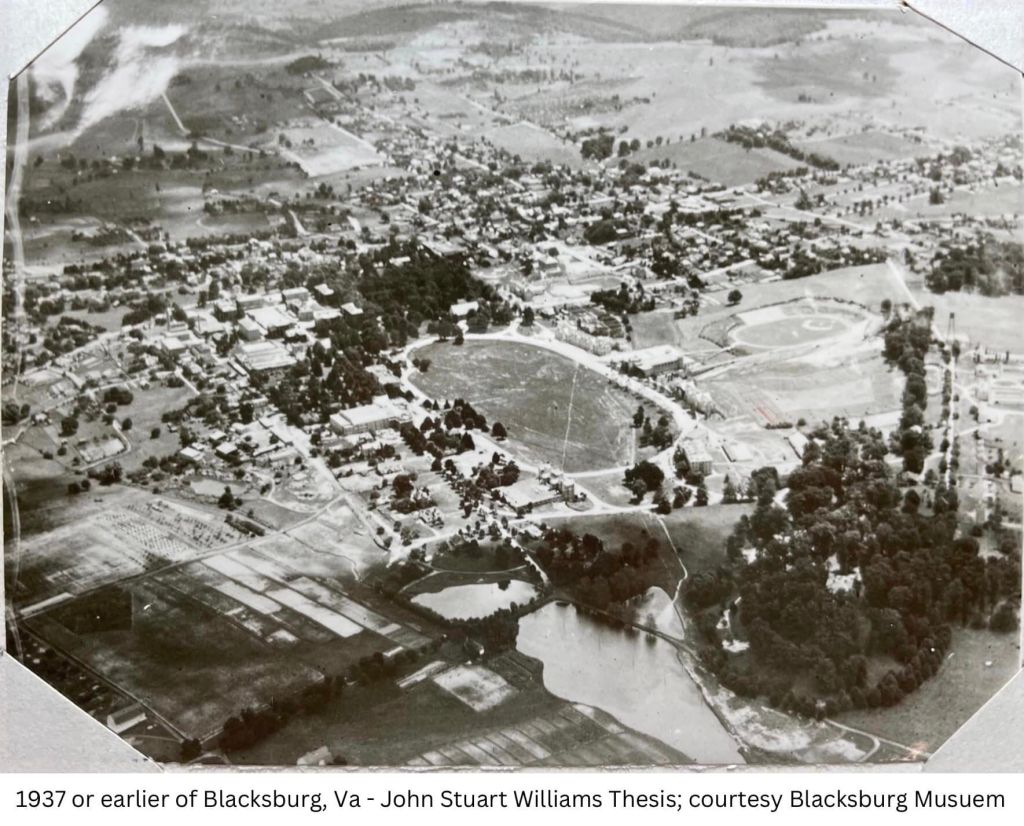
The aerial provided in this thesis is a northeastern view towards town. The newly created duck pond is at 6 o’clock. The drill field oval is obvious. Miles Stadium was newly built and stood about where AJ dorm stands (about 2 o’clock). Note the tall and black water tower about 3 o’clock and to the right of Miles Stadium.



 Gathering Blacksburg History