1870 – 1935
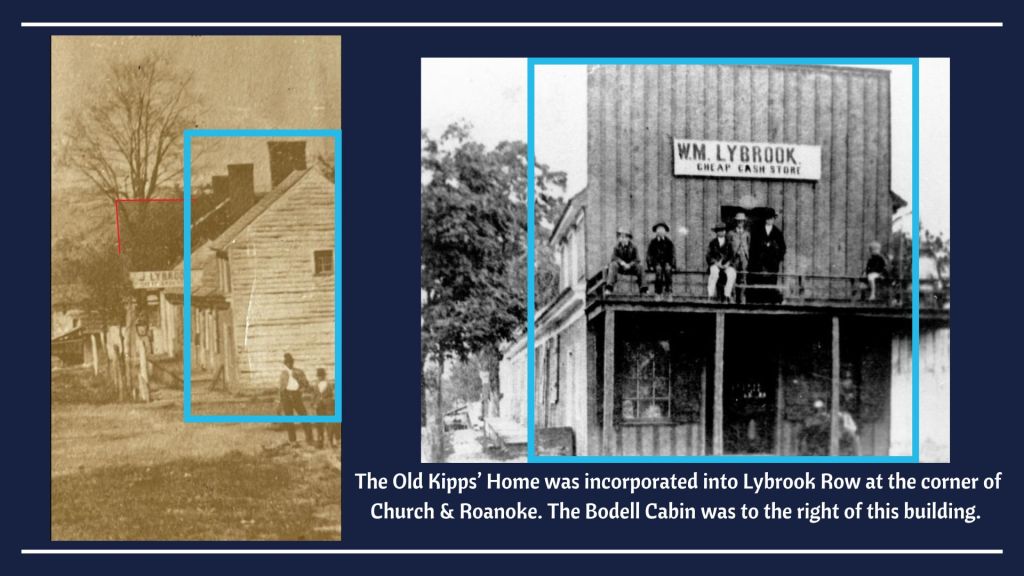
According to the deed search, Woodward R. Gitt (Baptist pastor) and his wife, Harriett Linkous Gitt were living near to Wm H. Martin (merchant living on the south-east corner of Penn & Roanoke St) in 1860 and next to the David Bodell (potter) in the 1870s. In February 1870, John & Mary EJ Lybrook sold 1/2 acre with a house, “where Gitt now resides.” This is the McGhee house property and included the small 2-room “cottage” (now known as the shed). In the 1880 census the widow Harriet Gitt was living in a house with her son, Frank and daughter, Alice. Next to that household of Harriot’s son, Charles and Nannie Gitt and their young daughter, Nora. Our guess is that Charles family was living in the small two room cottage (shed). In 1904 Charles D. and Nannie Gitt sold the entire property to William Lybrook (both the house fronting on Roanoke and the cottage), with a Life Right to Harriet Gitt. Harriet was living in the cottage, accessed by Penn St, as it does now. The Bodells were living in the newly built gable-roof house, to the left of the Gitt house.
William Murray and Ida Chapman Lybrook lived in the house that Katrina will purchase but not after a few years. William died in 1925, so the Lybrook Row and 204 Roanoke property were probated. That got messy due to debts and a will. In the end Guy F. Ellett and Hunter J Phlegar sold to National Bank of Blacksburg in 1937. We believe that Mrs McGhee was renting the house by 1935. On Feb 1, 1939 NBB sold the property that included lot #33 and 35 (excluding the Pedigo lot). She also bought the “cottage.”

1935-1968
Mrs. Katrina Rhodes McGhee led a busy life. From 1935 until she sold the house to Christ Episcopal Church in 1968, she managed a boarding house for male students of VPI. It’s believed that four courageous individuals resided in her basement, with an additional two to four on the main floor. In addition to this, she operated a Tea Room in the back of her home.
1968-1997
For nearly 30 years the house was used as an office by APSO after Mrs McGhee sold it to the church.

APSO — Appalachian Peoples Service Organization — was founded by the Rev. B. Lloyd, with its “world headquarters” for the purposes of advocacy, education, and ministry among the people of the Appalachian Region. Long-time parishioner, Sally Mackie served as the secretary for the multi-diocesan organization. Eventually APSO evolved into Episcopal Appalachian Ministry and was recognized as an organization, and partially funded by the Episcopal General Convention.
1997-2019
In the 1997, the church opted to lease rooms to Canterbury Ministry students, prompting extensive renovations to enhance the layout and amenities of the house. The accompanying diagram illustrates the original configuration prior to the renovation. Notably, the large enclosed back porch was situated where the current back deck now stands. Furthermore, the side deck functioned as a covered utility room with access to the basement.

2019 – Present
After the last student left for the summer of 2019 the house was used for storage of yard sale donations until 2023.
What is the construction date of the house, and which section constitutes the original structure?
Upon thorough examination by numerous professional architects and historians, this house has undergone a series of additions and modifications over time. The prevailing theory suggests that the house was constructed in the late 1800s. The oldest section comprises the front part, including the porch and two rooms adjacent to the central hall. It’s speculated that the back originally featured a shed-style roof that was removed during expansion.
Is the McGhee house as old as 1870s? The thought is maybe, but the small two room cottage close to the Great Hall could easily be that old. The McGhee structure was definitely built before 1880. The other possibility is that there was a structure on the site that predates the current structure.
Gibson Worsham – Survey of Historic Architecture in the Blacksburg Historic District, Montgomery County, VA 1997 provides a sketch (page 50, pdf) of the interior and a photo of the house. The interior sketch is annotated to exemplify the additions and modifications.
The two corner fireplaces were constructed at different points in time, although the tile dates back to the early 1900s. Interestingly, the house bears resemblance to the Siebold house (noted on page 73 of pdf on Jackson Street, which has been dated to the 1890-1900s.

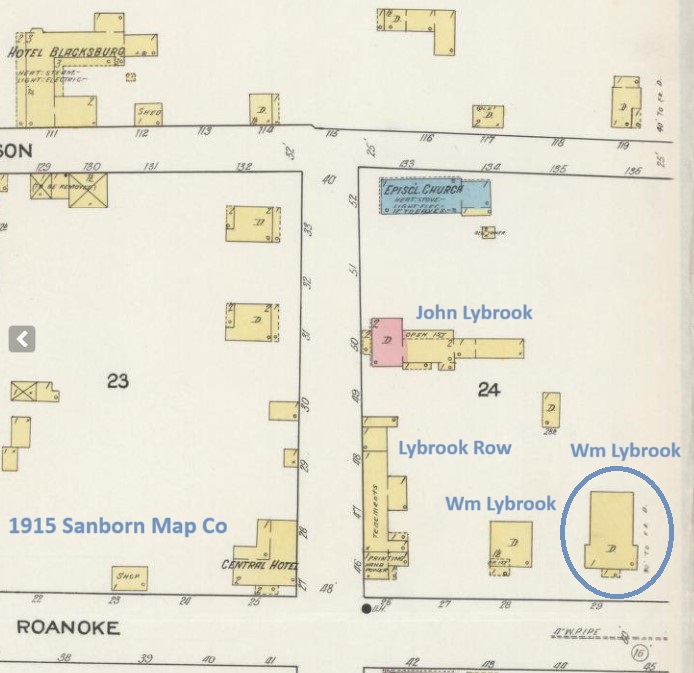
This is the 1915 Sanborn Fire Map with the structures labeled. From left to right along Roanoke Street: Lybrook Row, Wm Lybrook (will be owned by Mrs Morgan), Wm Lybrook (will be owned by Mrs McGhee by 1939).
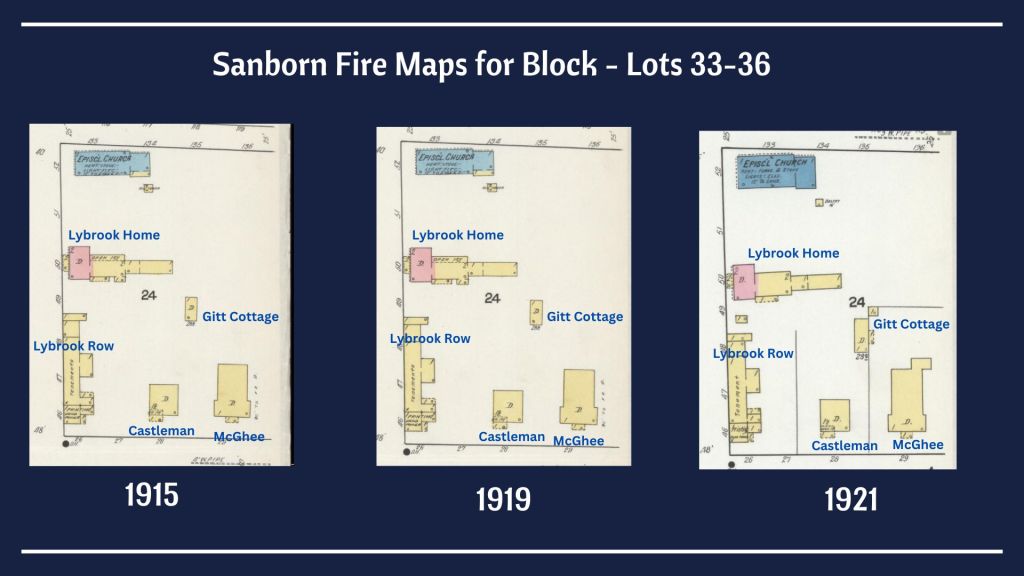
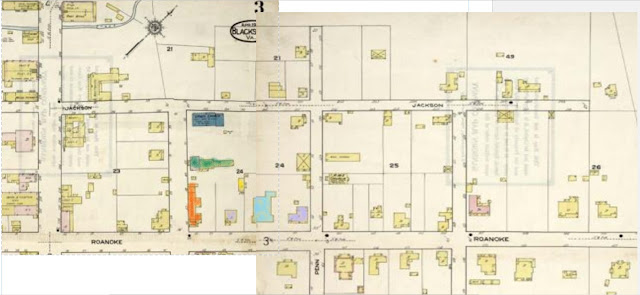
The 1921 Sanborn Fire map displays a roofline closely resembling that of the house before the 1997 remodel. We assembled the Sanborn map, highlighting and color-coding the various structures within the block. The McGhee house is represented in light blue. Additionally, it’s worth noting that Penn Street extends beyond Jackson St, and Progress Street was nonexistent in 1921.
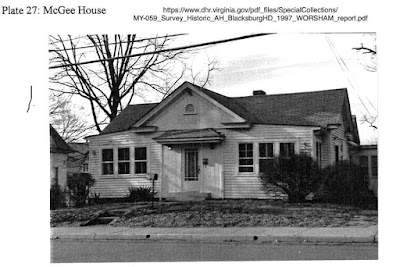
Gibson Worsham’s sketch of the McGhee house plan in 1996-97. His document states that the house was used as a boarding house. This sketch is not accurate, but provides a glimpse of his impression.

Social Media Information Blacksburg, Memories of the Way We Were
Search on McGhee for information
The Evolution of Christ Episcopal Church Campus

 Gathering Blacksburg History